Temperature
Cold honey becomes thicker.
Warm honey becomes more fluid.
That means the exact same honey can behave very differently depending on whether the bottle has been sitting in a cool cupboard or a warm kitchen.
Water Content
Honey naturally contains some water. The amount can influence its thickness and how quickly it flows.
A honey with a slightly different moisture level may therefore look completely different during the upside-down test.
Flower Source
Bees collect nectar from different plants, and the resulting honey can have different colors, flavors, aromas, and textures.
Some varieties are naturally runnier, while others are noticeably thick.
Crystallization
Honey can naturally crystallize over time.
Some honey varieties crystallize quickly, while others remain liquid for much longer.
Crystallized honey may look completely different when you turn the container upside down—but crystallization does not automatically mean the honey is fake.
What About the Bubble?
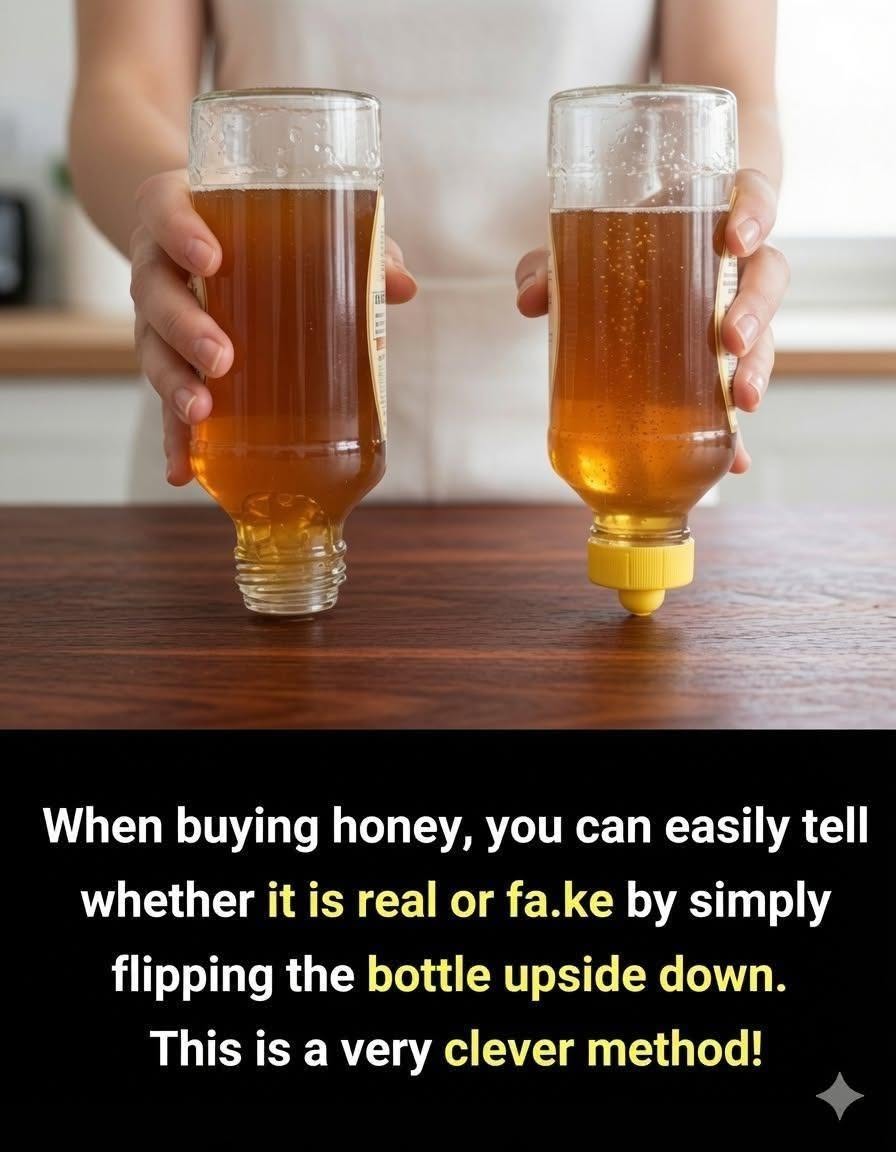
Another version of the trick focuses on a bubble that appears inside the bottle.
The idea is that thick, genuine honey supposedly traps a large bubble that moves slowly when the bottle is inverted.
Again, this can be an interesting observation, but it isn’t a dependable laboratory test.
Bubble movement is affected by viscosity, temperature, container shape, air pockets, and other physical factors.